
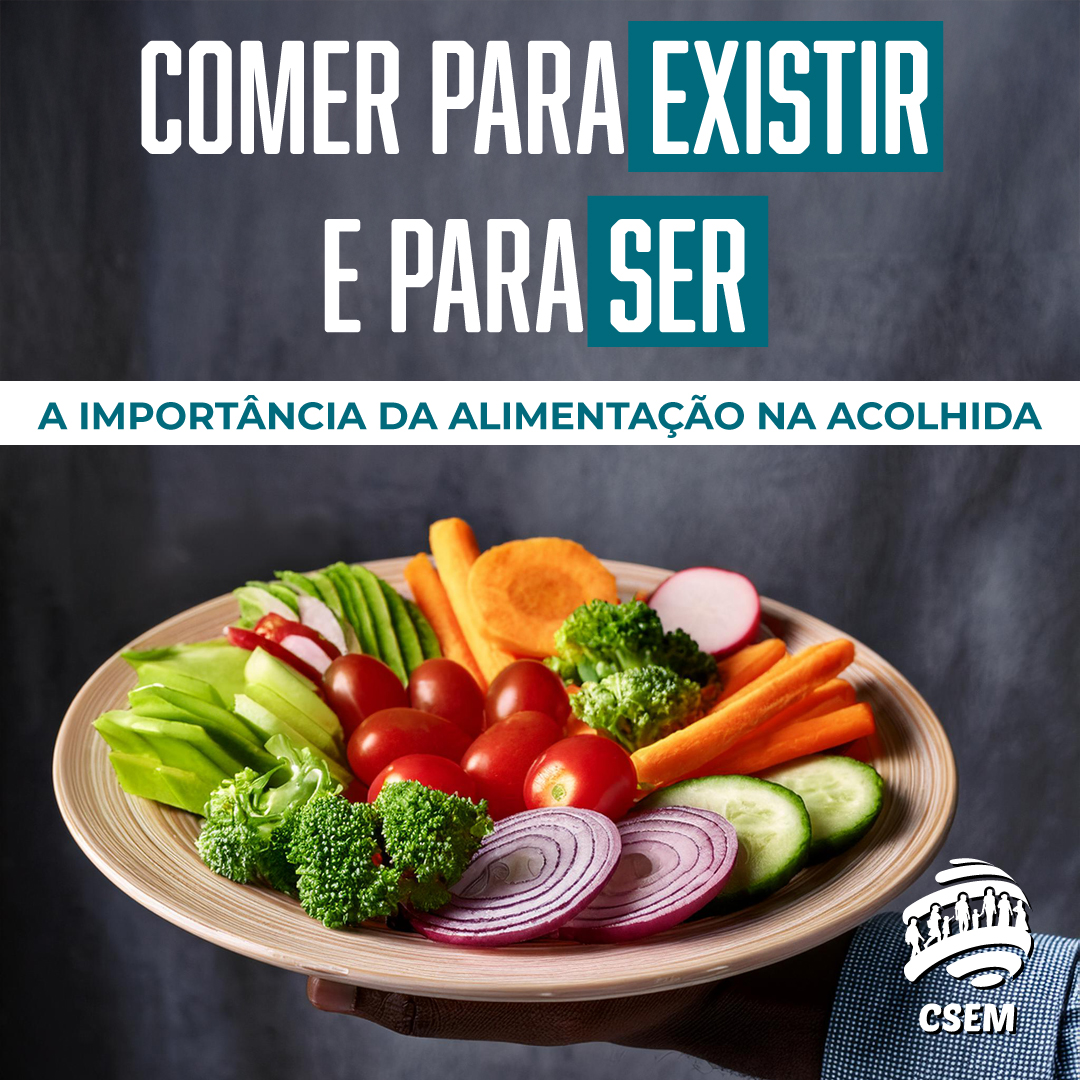
Human history is circumscribed by migratory processes, which take place voluntarily or not, and the people involved in these changes need to reorganize their daily practices to adapt to new geographical spaces and cultural contexts, creating a synergy of actions that intertwine the familiar and the unknown. In this context of discoveries and new experiences, migrants seek comfort in the memories of their previous lives. Reuniting with the familiarity of culture is a constant that gives life new meaning and acts as a reference for rebuilding the future. Food has this welcoming character, bringing comfort when cooking and tasting typical dishes.
In this sense, a migrant is trying to recreate his life away from home, and food, along with the food used, occupies a central place in daily life, acting as an important element. This is how eating, considered a biological act, becomes intertwined with culture and identity. Food culture is that first thing that moves along with the migratory flow of people, bringing with it preparation techniques, seasonings, practices for staying at the table and how to pick up food, even the number of meals in a day. Food is crucial to maintaining cultural identity (Altoé and De Azevedo, 2018, n.p.).
It is important to understand that not all food is food; it is cultural customs and traditions that have an impact on these food choices. The food system is defined through a set of production and consumption processes for those products that are considered food. Food only becomes food when it is socially and culturally accepted by a certain group, and this process goes far beyond its nutritional value (DORIA, PELLERANO, 2019).
Food that becomes food is the result of a cultural process that brings identity to a community. In this sense, eating is expressing belonging to a particular group, which externalizes the meaning of knowledge, memories, emotions and sensations shared throughout its history.
In the context of migration, human displacement and refuge, welcoming those who have left their lives behind because of events so far removed from their expectations needs to be based on food security, culture and migration. For Altoé and De Azevedo (2018), the permanence of these practices is fundamental to maintaining the identity of migrants and refugees because they are full of symbolic factors. Food is memory, affection and resistance. You don't just eat because you're hungry in the physiological sense, but because you need to feed your emotions and memories, to remember important moments and situations.
In institutional reception spaces, it is important to bear in mind that those being received are dependent on institutional structures due to their high vulnerability, that food security is important as a health promoter and that cultural difference underpins the identity of migrants and refugees. My experience as a migrant/refugee in Brazil inspires this reflection. Coming from Venezuela in a context of forced migration, after years of vulnerability and lack of protection of my basic human rights in my country, I decided to leave my home - a difficult decision that always leaves its mark. In addition to the migratory process, the impact of this extreme decision led me to a state of what I call hopelessness, marked by deep emotional and psychological fatigue, which empties the person of their humanity.
Finding oneself implies receiving support in different aspects to rebuild life outside our cultural and emotional boundaries, as well as territorial ones. Institutional shelters dedicated to this purpose have the noble task of helping with this personal reconstruction and, in my opinion, placing the human, bio-cultural duality in an important, almost central place. This implies not only feeding the body, but also the Being. Food is nourishment for existence and for be.
References
de Souza Lima, R., Ferreira Neto, J. A., & Pereira Farias, R. de C. (2015). FOOD, EATING AND CULTURE: THE EXERCISE OF COMMENSALITY. DEMETRA: Food, Nutrition & Health, 10(3), 507-522. https://doi.org/10.12957/demetra.2015.16072
Dória, C., Pellerano,J. (2019). FOOD VS. FOOD: CULTURE AND NUTRITION FROM THE "FOOD FOR ALL" PROGRAM IN SÃO PAULO. Revista do Centro de Pesquisa e Formação Nº 8, July 2019. 120-130
Altoé, I. and De Azevedo, E.. (2018). Migratory food: food culture and refugee identities.Revista del CESLA, núm. 2,. 247-264.