
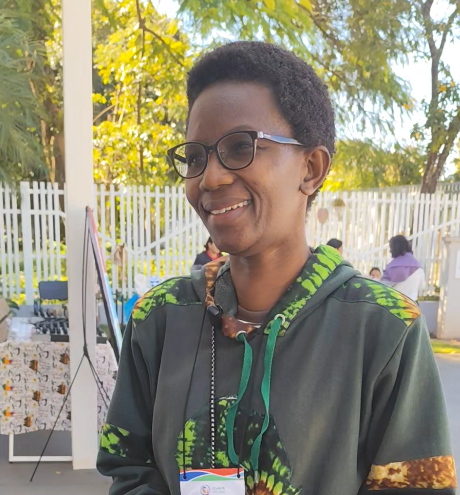
During the 3rd International Conference on Migration and Refuge (ICoMiR), held between May 19 and 22 in Brasilia, Pelagie participated by selling clothes and handicraft products at a stall outside the event, while also attending some of the talks that were taking place. On the last day of the meeting, she was chosen to be one of the spokespeople for the final document - a symbolic recognition of a trajectory marked by struggle, care and hope.
A migrant from the Democratic Republic of Congo, Pelagie left the country to escape the prolonged violence. "We are looking for a place to live in peace. Congo has been at war for a long time. This situation is not good for a child. One day you can go to school, the next day you can't. Sometimes I would stay at home for months. I've lived through this since 1995 and I didn't want my children to go through the same thing."
Now in Brazil, it was the desire to ensure security and dignity for her children that motivated Pelagie to migrate. Now she's trying to rebuild her life through entrepreneurship. "I brought African clothes to sell: jackets, pants, T-shirts... That's what I can do now to live with dignity," she says.
Despite the difficulties, Pelagie finds strength in motherhood. The mother of eight children, she is especially proud of her two daughters who are studying at the University of Brasilia (UnB). "This is an act of solidarity. UnB gives opportunities to everyone. If you have a document and the necessary level, you can get a place. This helps us a lot." As well as being a source of pride, the daughters also play an active role in their mother's routine. Whenever possible, they help out with the younger siblings and even with the sales. "When they have free time, they accompany me and help me with the business. And they also help me with my Portuguese - they're always explaining words to me, teaching me how to speak better."
Balancing work with childcare, however, has not been easy. After four months in a formal job at a pharmacy, she had to give it up. "I lost five kilos, I couldn't cope with everything. But I can't just sit back. So I started selling what I know how to do." On her days off or during the school vacations, she intensifies her sales with typical African foods.
And learning the language was also a challenge: "There we speak French, Lingala and other languages. Here it's only Portuguese. But we're learning. It helps me in the hospital, in the market, at school," says Pelagie during an interview with the Scalabrinian Center for Migration Studies (CSEM).
Participating in ICoMiR was a transformative experience for her. "I felt welcomed. I discovered that there are organizations that care about immigrants and want to guarantee our rights. That makes me feel good." The event brought together more than 200 people in person and around 800 virtually, representing 30 countries. It was the continuation of the first editions held in Johannesburg (2018) and Tijuana (2023). Refugees, migrants, academics, activists and representatives of institutions shared experiences and reflections around the theme: "Understanding, humanizing and valuing people on the move."
Pelagie believes that spaces like this give visibility to voices that are usually silenced. And she leaves a message for other migrant women: "You have to have courage. Learn the language, look for opportunities, trust that there are good people here. There's always a way to live better."