
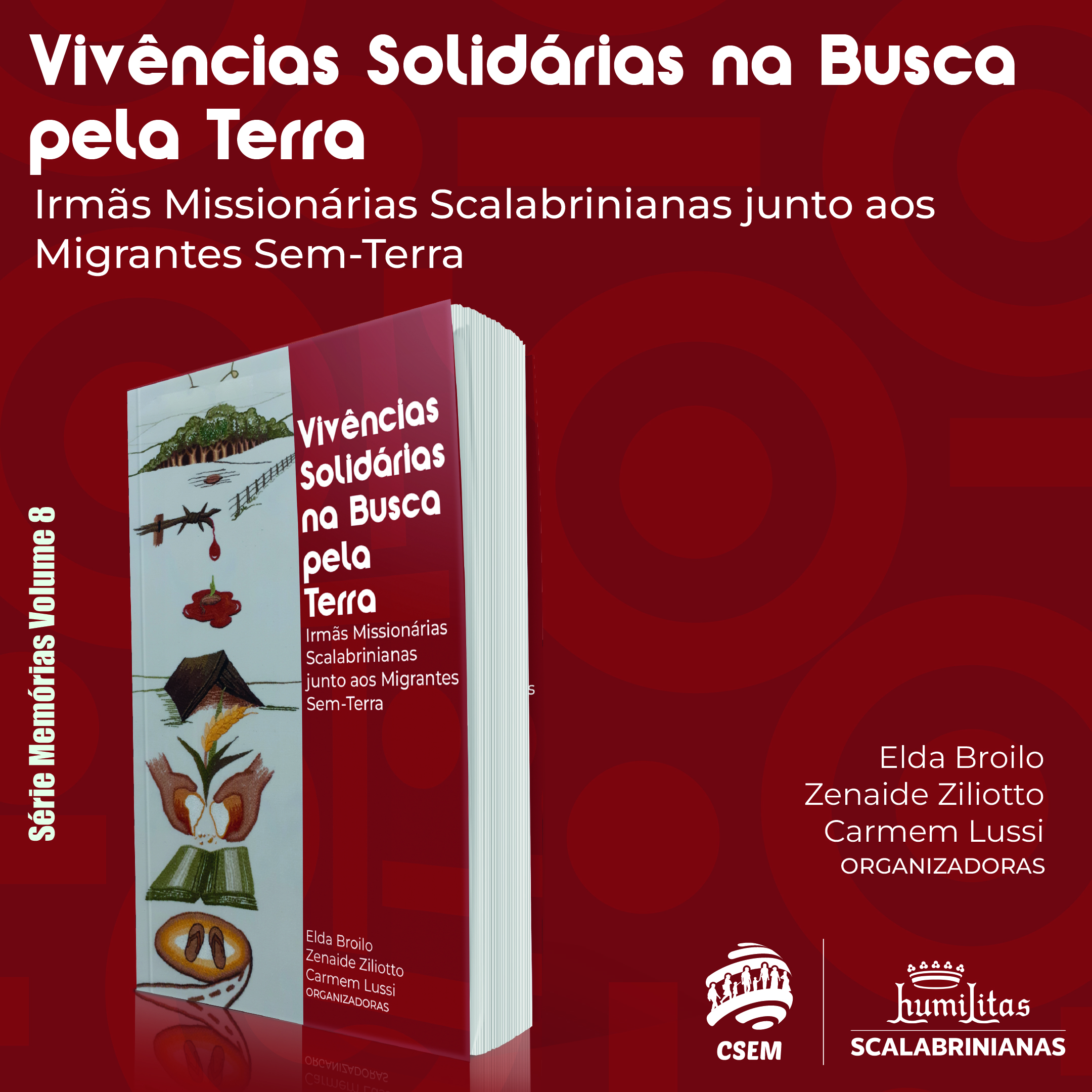
For nearly 50 years, since 1971, the Scalabrinian Missionary Sisters (MSCS) have been directly involved in the struggle for life, bread and dignity among landless migrants in 11 Brazilian states. Memories of the MSCS Sisters' missionary work are now being published in the book Experiences of solidarity in the search for land. Scalabrinian Missionary Sisters with landless migrants.
The work was organized by the Scalabrinian Center for Migration Studies (CSEM), with the participation of dozens of Sisters who worked with landless workers, in urban contexts, such as the outskirts of Goiânia - GO or Cariacica, ES, for example; or in rural contexts, in Goiás, Rio Grande do Sul, Mato Grosso do Sul, among other states. With the advice of theologian Carmem Lussi and historian Sergio Coutinho, hundreds of pages of narratives of the MSCS Sisters' work have been organized in this publication which, in addition to rescuing the meaning of those experiences, reinforces communion and solidarity for the cause of life with dignity for all, with an emphasis on the search for land, with justice and dignity, in Brazil.
In the introduction, historian Sergio Coutinho states that the work of the Scalabrinian Missionary Sisters with landless workers, which is highlighted in this volume, stands out because it intertwines memory with history and recognition emerges as a transformative element. “Memory, embodied not only as an archive of the past, but as an active force in the construction of meaning, becomes a crucial tool for giving voice to the marginalized, rescuing silenced narratives and redefining collective histories. Recognition, in turn, emerges as an ethical and political act, making it possible to value the experiences of those who have been historically excluded. By working with landless migrants, the Scalabrinian Missionary Sisters not only witnessed the struggles of these communities, but also committed themselves to recognizing their dignity, seeking profound social and historical transformations.” On the 40th anniversary of the Landless Workers' Movement (MST), the Congregation offers yet another contribution to landless migrants with this publication, which recognizes, in the narratives and memories of the facts and meanings of decades of collaboration, the importance and greatness of the journey that is now being celebrated.